
Prague was an unexpected affair for me. I arrived armed with expectations, a mental list of must-sees, and the confidence of someone who thought she knew what she was getting into. I did not expect to fall in love — or to feel the city quite as deeply as I did.
To me, Prague feels like a city that was born again, yet somehow remembers everything. Every street seems to carry a past life, every building quietly showing off its survival skills. It’s the kind of place that captures you within minutes — whether you’re here for history, food, architecture, or simply a good excuse to wander aimlessly.
Here’s why Prague deserves a spot on your travel list this year.
By Little Chilean
The Czech capital welcomes you like an old-looking but charming small city at first sight. But the deeper you go into its streets, and the more time you spend strolling around, the sooner you get to realize that what you see is only a facade. Prague holds centuries of history written by every historic event that has hit Europe, and it has left testimonies everywhere for you to see.
And even though its landmarks preserve beautiful architecture mainly of Baroque and Gothic style that speaks of its influences, it’s the history beating throughout the whole city that is simply spellbinding

Once you visit Prague — especially the Old Town Square and its surroundings — you’ll understand almost instantly why its historic centre earned a place on UNESCO’s World Heritage list in 1992. Built between the 11th and 18th centuries, the Old Town, the Lesser Town and the New Town reflect the immense architectural and cultural influence the city has enjoyed since the Middle Ages. As UNESCO itself notes, many of Prague’s most striking landmarks — including Hradčany Castle, St. Vitus Cathedral and Charles Bridge — were largely built in the 14th century under the rule of Holy Roman Emperor Charles IV.
Prague feels like a city that has either stopped in time or gently awakened after decades of sleep. It feels renewed, open and welcoming, yet remains deeply historic and almost sacred. The city carries memories of many dark years, but instead of presenting itself as a mausoleum, it wears its past with pride — visible on every street corner.
As a key part of a country shaped by world wars and dictatorships, Prague has lived through some of Europe’s darkest chapters. Remarkably, much of its architecture remains untouched. Alongside this, new landmarks have been built to honour those who suffered through these human catastrophes. Today, the city doesn’t feel like it is mourning its past, but rather acknowledging it — proud of the second chances it was given, openly showing what happened and how resilience and resistance helped it move forward. It’s difficult not to feel inspired.
For me, visiting Prague feels like warmth after the rain — a moment that exhales appreciation, memory and gratitude. And that’s something worth acknowledging too.
That said, history isn’t all Prague has to offer. Mesmerising architecture is scattered across the city, creating a landscape that feels particularly magical in winter and during the holiday season. Add to that an impressive range of museums, exhibitions and galleries, delicately balanced with markets, restaurants and independent shops, and you have a city that welcomes every kind of traveller.
In case it wasn’t obvious, I loved Prague. Even a short visit was enough to leave a lasting impression — and a desire to return. It made me want to learn more, discover more, and engage more deeply with its history and culture. So, doing what I do best when I fall in love with a place, I’ve put together my ten things you must do when in Prague.
1. Visit a war history museum
As mentioned before, memorials and museums are all over Prague. Personally, I’d highly recommend the National Memorial to the Heroes of the Heydrich Terror. Located beneath the beautiful Baroque Orthodox Cathedral of St. Cyril and Methodius, the museum was established in 1995 as an underground space beside the crypt.
Its location alone invites visitors to walk through history: this very site once served as the hiding place for seven Czechoslovak paratroopers who fought against Nazi German forces in 1942, during the mission known as Operation Anthropoid.
2. Take a chill half-day walk through Prague Castle
This one isn’t just for history or monarchy buffs. Covering more than 70,000 square meters — see why I recommend setting aside half a day? — this landmark dates back to the 9th century and, according to the Guinness Book of Records, is the largest ancient castle in the world. Today, it serves as the official office of the President of the Czech Republic, and throughout history it has been a seat of power for the kings of Bohemia, Holy Roman emperors, and later, presidents of Czechoslovakia.
But this vast attraction is far more than just a castle. From the moment you walk through its gates, you’ll find lush parks, scenic viewpoints perfect for slowing down, and striking architecture — yes, it feels more like a small village than a single fortress. Within the castle walls, you can wander colourful streets like Golden Lane (Zlatá ulička) and admire the breathtaking Gothic cathedral, which is simply impossible not to stare at — even if you’re a full-on atheist.
A quick tip: you’ll need to purchase a ticket at the entrance or online to access many of the interior attractions, but most of the outdoor areas are free to explore.
3. Enjoy a potato soup on bread
Yes, potato soup is a winter comfort classic around the world, and it didn’t necessarily originate in what is now Czechia — but bramboračka did. This traditional Czech potato soup is often served inside a hollowed-out bread roll, which, to me, is the most exciting part (even though I’m a devoted soup lover and happily enjoyed the contents too).
This hearty dish is a firm favourite across the Czech Republic. While carrot, celeriac, onion, parsnip and dried mushrooms all make an appearance, potato remains the star ingredient. It’s seasoned with dried marjoram and, occasionally, caraway seeds. Fair warning: it’s surprisingly filling.
You’ll find bramboračka in most restaurants serving local cuisine, and it’s refreshingly affordable.
4. Go to the Museum of Illusions
Illusion Art Museum Prague (IAM Prague) is the Czech Republic’s first museum dedicated entirely to illusion and trick art. If you’ve visited a similar museum elsewhere, you’ll know what to expect: a clever mix of education and entertainment, packed with interactive, photogenic displays that are genuinely fun to explore.
What I loved most is that it works just as well for kids as it does for adults. To me, it felt like a grown-up playground — a place where curiosity is not only allowed, but actively encouraged. 3D and perspective-based illusions are seamlessly blended with history and art, with each display referencing figures from Czech history. You leave not only with great photos, but also with a surprising amount of new knowledge.
The perspective installations, in particular, will have you questioning what you’re actually seeing. Their meaning can be tricky to grasp at first — and that’s exactly the point. Interestingly, everything suddenly makes more sense when viewed through your phone. The staff will explain this along the way, but it still leaves you wondering how your eyes and your camera lens can interpret the same scene so differently. It’s genuinely fascinating.
As IAM Prague puts it on its website, its “exhibits bring to life historical techniques of creating illusions in art into the 21st century’s selfie and social media age, with a touch of local flair, and encourage guests to touch and interact with all of its exhibits.”
Conveniently located in the heart of Prague, between Old Town Square and Wenceslas Square, it’s easy to fit into any itinerary. For more information and tickets, visit iamprague.eu.
5. Touch the sky from the Clock Tower

The Prague Astronomical Clock, or Pražský Orloj in Czech, is a medieval astronomical clock attached to the Old Town Hall, right in Old Town Square. First installed in 1410, it holds the impressive title of being the oldest astronomical clock still in operation.
If you’re there exactly on the hour, you’ll get to witness The Walk of the Apostles: a short show of moving figures and sculptures striking the time. If that alone isn’t intriguing enough, there’s also a legend attached to the clock — one that says the city will suffer if it’s neglected or if its proper functioning is put at risk. No pressure.
But that’s not all. The building itself features an observatory deck offering a stunning 360-degree view over Old Town Square and its surroundings. It’s absolutely breathtaking. Just be prepared for the many stairs on the way up — or practise patience and wait for the lift.
6. Feel the holiday season in Old Town Square
Now, I’m sure Prague is just as magical during other seasons, but I can only speak from experience — at least until I return in a few months. Visiting in December meant falling headfirst into the winter wonderland atmosphere of Old Town Square and its Christmas market.
During the festive season, the square fills with warmth, scented with mulled wine and gingerbread, thanks to rows of brightly decorated wooden huts. The market sits right in the heart of the square, framed by the Astronomical Clock, the Church of Our Lady before Týn, and a massive Christmas tree. You’ll find local handmade crafts and traditional Christmas treats — including the famous trdelník, a sweet pastry made from rolled dough, wrapped around a stick, grilled, and topped with sugar and walnuts. Honestly? A full-on foodgasm.
7. Walk the Charles Bridge

I’m not sure how common it is to love bridges, but I find them endlessly fascinating. There’s the architecture, of course, but also the symbolism — bridges as connectors between two sides of the same city, and everything that connection represents.
Construction of Charles Bridge was completed in the early 15th century, and it remained the only crossing over the Vltava River until 1841. For centuries, it served as the main link between Prague Castle and the Old Town, making the city a crucial trade route between Eastern and Western Europe.
The bridge is lined with 30 statues and statuaries, mostly Baroque in style. While the originals were erected around 1700, they’ve since been replaced by replicas. The figures depict various saints and patron saints venerated at the time, including St. Luthgard, the Holy Crucifix and Calvary, and John of Nepomuk.
And beyond all that history, walking across Charles Bridge simply offers mesmerising views. It feels like a pathway to something big and unexpected, and its panoramas over the city and the Vltava River alone are reason enough to take the walk.
8. Stay at Mosaic House Design Hotel
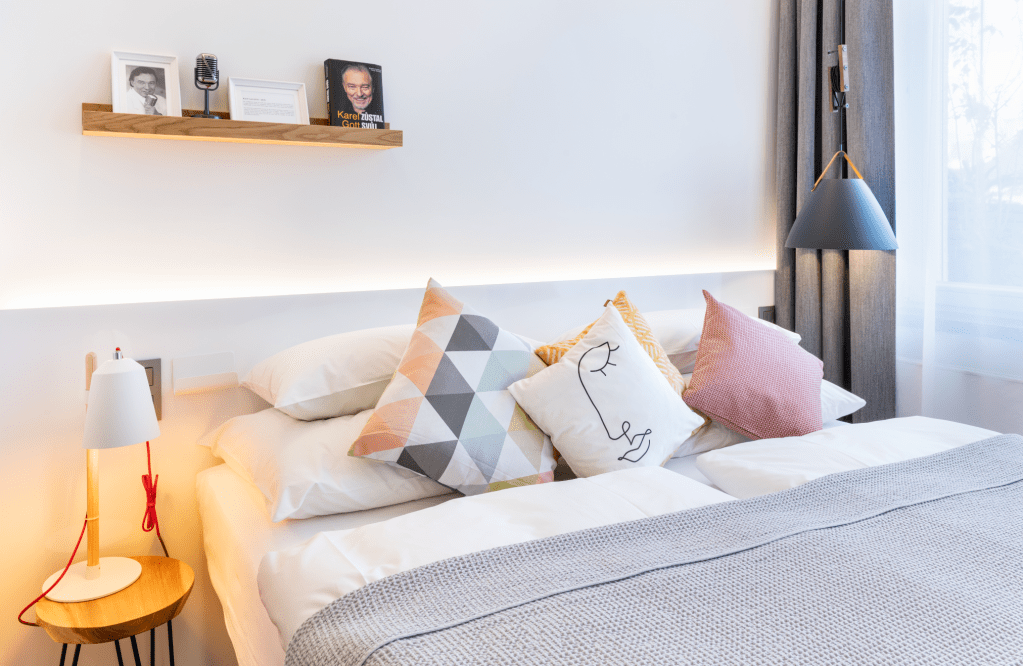
You can’t really dive into a new city without a good night’s sleep — preferably somewhere well located. But what if that stay were also as sustainable as possible? Enter Mosaic House Design Hotel.
While in Prague, consider staying at Mosaic House Design Hotel, reportedly the most sustainable hotel in the Czech Republic. As they put it on their website:
“Enjoy all the comforts of home in a cosy atmosphere at Mosaic House. From Standard rooms to Penthouse suites with Prague Castle views from private terraces, we’re sure to have the right accommodation to make your visit memorable.”
Still not convinced? The hotel also features a cosy café — ideal for digital nomads — as well as a co-working space and a spa.
Mosaic House is located in the city centre, yet just far enough from the hustle and bustle to feel calm. It places you within walking distance of major sights, shopping areas, museums, and both Old and Lesser Town.
Find them at Odborů 278/4 | 120 00 | Prague 2, Czech Republic.
9. Drink a cold Czech Pilsner
Did you know Czechia has the highest per capita beer consumption in the world? According to the Global Beer Consumption by Country index (2019), Czechs top the list with an average of 140 litres of beer per person per year.
And yes — they know it. So when in Prague, make time to refresh and recharge with a Pilsner in the country where it actually originated. Just make sure it’s poured properly. That means a generous amount of foam — or, as I learned, a full foam moustache. That’s how you know you’re doing it right.
Czechs understand the art of patience, at least when it comes to beer. Waiting for the foam is essential for flavour. As explained on the Pilsner Urquell website, “a thick head of dense, wet foam seals in the freshness, protects our delicate flavours from oxygen, and creates the perfect balance in our beer.”
Science, again, is on their side.
10. Immerse yourself in Franz Kafka’s world
Whether you read The Metamorphosis at school (I did) or you’re a devoted Kafka fan, this museum is well worth a visit. The Franz Kafka Museum, located in the centre of Prague, offers a deep dive into the writer’s world.
Born in Prague in 1883, Kafka is one of the most influential figures of 20th-century literature, and this museum makes a strong case for it. The collection includes first-edition books, letters, diaries, drawings, manuscripts, and photographs never before exhibited in Prague. Everything is presented through 3D installations, audiovisual elements, and an immersive soundtrack. Simply fascinating.
Entrance is around €10.
10 things you must do while in Prague
- Visit a war history museum
- Touch the sky from the Clock Tower
- Feel the holiday season in Old Town Square
- Take a chill half-day walk through Prague Castle.
- Go to the Museum of Illusions
- Enjoy a potato-soup on bread
- Stay at Mosaic Budapest
- Walk the Charles Bridge
- Drink a cold Czech Pilsen!
- Immerse yourself in Franz Kafka’s world
Bonus: Visit The John Lennon Wall

Located just a few minute’s-walk from Charles Bridge, this space was first decorated after the assassination of Lennon in 1980. Ever since, it has been painted and repainted with several messages supporting global ideals such as love, peace and climate change.
 Life Lovers Magazine®