

Nothing says ‘personal growth’ quite like nearly dying alone on a mountain, right? While most of us are stressing and panicking over a bad Wi-Fi connection, alpinist Jost Kobusch casually stares death in the face on ice-covered peaks, proving that solitude and subzero temperatures are just another Tuesday. Or take Tamara Klink, navigating perilous, lonely waters on her solo ocean journeys, where survival becomes a constant battle against nature’s might. But here’s the thing—fear isn’t just for the extreme adventurers of the world. It creeps up on all of us, whether in the form of an avalanche or an unexpected panic attack at a Pret A Manger. So, what do we do? Run? Hide? Or, like Kobusch and Klink, do we learn to embrace fear, listen to it, and keep moving forward? Let’s talk about it.
by Danielle Lima
@danilima_dl
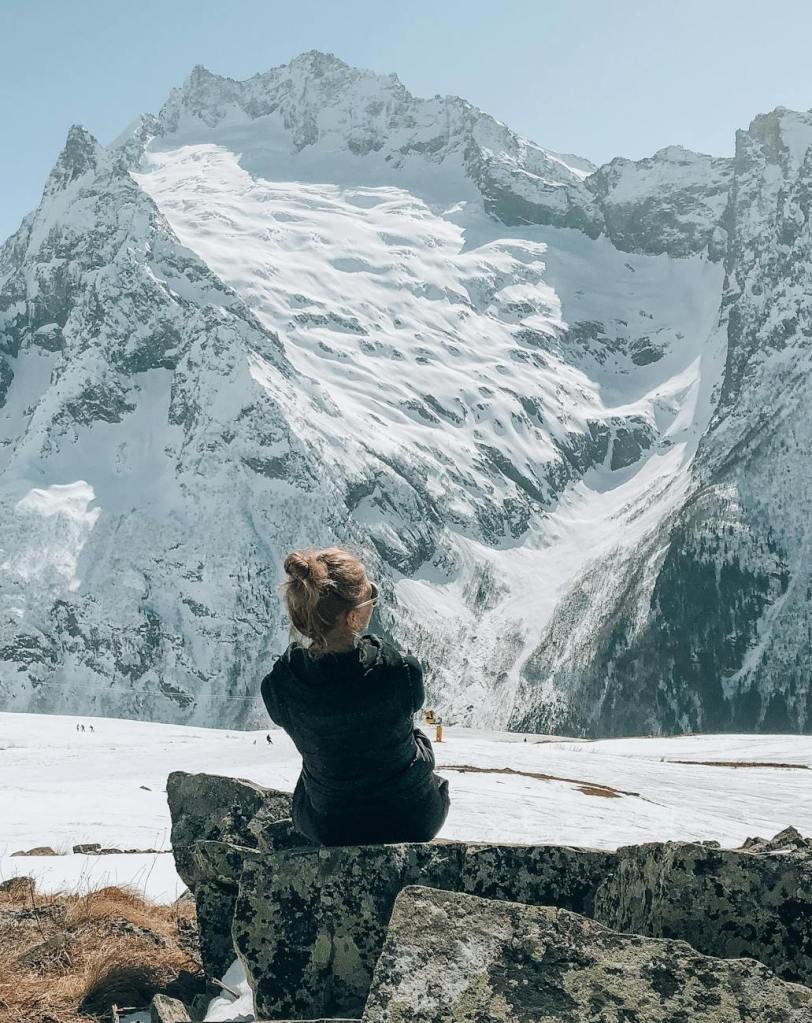
After surviving an avalanche on Everest, alpinist Jost Kobusch, who dedicates his life to solo expeditions in some of the world’s most extreme and inhospitable places, was the first person to reach the peak of the untouched and majestic Nangpai Gosum II, in 2017, a landscape so desolate that “not even a single living being is sighted, not even a bird.” Such harsh solitude doesn’t merely isolate; it clears away the distractions of everyday life, leaving one face-to-face with existence itself: raw, unfiltered, and primal.
I came across Jost’s story on a rainy, lazy sunday afternoon while casually browsing youtube. I had never heard of him before, but as he recounted his adventures and challenges in nature, I found myself completely captivated by his extraordinary ability to confront the unknown and persevere against odds that most people would consider impossible.The screen filled with breathtaking imagery of vast, untouched landscapes that seemed almost surreal, featuring scenes of him climbing daunting, treacherous mountains, which left a strong impression on me.
Yet, what drew me in wasn’t just the daring feats or the raw beauty of the wilderness; it was something deeper, something profoundly human. Jost’s connection to the mountains extended far beyond the sport, its technicalities, or its details. His mantra, ‘learn or die,’ resonated powerfully, capturing the essence of his documentary, Alone to an Unclimbed Peak. It wasn’t just about conquering new heights but about improving, reaching his best, and going beyond what he believed to be his utmost limit. It was also about confronting a looming fear—the kind of fear I, too, had faced, though in an entirely different context.
I’ll tell you how it unfolded for me: like a storm. It was a surge of mental and physical turmoil that gave way to this deep solitude, like standing on the edge of existence. It was unfamiliar, impossible to put into words. It felt like one of those sink-or-swim moments, where you’re forced to face the chaos inside you. There’s no way around it, the only way out is through. One ordinary day, as part of my routine, I grabbed my bike and headed to a nearby restaurant. But on my way there, something felt off. My heart skipped and quickened, followed by a fleeting wave of fear unlike anything I had ever experienced. By the time I reached the restaurant, I was overwhelmed by a sense of dread so unique that it’s still difficult to articulate even today.
I parked my bike, walked in, and sat down, waiting for my order, already unsettled by the strange discomfort that had left me trying to make sense of what had just happened. But then, without warning, that odd feeling hit me again, this time even stronger, completely taking over and catching me off guard. My heart started pounding violently, my breath came in fast gasps, and my vision blurred. For what felt like an eternity, though it was probably less than a minute, I was convinced my heart was failing, that I was about to have a heart attack or maybe even die. A short time later, I found myself sitting in a cardiologist’s office, feeling desperate. To my astonishment, the doctor calmly explained that what I had experienced wasn’t the onset of a heart attack, but an acute bout of anxiety.
Anxiety? I had always considered myself an anxious person, but to me, anxiety had always seemed different, less cruel, more benign, almost like a common symptom of modern life, something we all share. The term felt too simple, almost absurd, given the intensity of what I’d just gone through. Yet, it was true. And that moment marked the beginning of my journey to understand fear, I mean, a kind of fear that, when it grows too big, becomes bigger than you.
Since that day, fear has become an unwelcome but persistent companion. Over time, I’ve come to understand with deep clarity the truth in Nina Simone’s words: “I’ll tell you what freedom is to me: no fear.” I was no longer free.
Amazingly—even to myself—I managed to cope without medication. It was a personal choice, ironically driven by my fear of medication and the possibility of side effects or further harm to my body, mind, and soul. Instead, I turned to meditation. That said, I don’t judge those who find comfort in medication. When I moved to London and began feeling the full weight of my anxiety and panic, I was surprised—and grateful—that the NHS recommended mindfulness sessions as part of my treatment. It’s an approach that views the body and mind as one, treating us as a whole. And today, I can honestly say it saved me.
Driven by a determination to break free from the constant cycle of worst-case scenarios and living in perpetual fight or flight, I began learning how to quiet my mind and fully embrace the practice. Meditation became more than just a tool; it became my survival, my way of life. It grounded me, equipping me with the skills to face fear, rather than succumb to it. I take pride in saying that fear no longer controls me. I’ve learned to navigate it, regaining not only a sense of freedom but also a renewed sense of self.
And speaking of navigating, another remarkable adventurer comes to mind: the Brazilian solo sailor and author Tamara Klink. Her awe-inspiring journeys, including spending a winter alone in the frozen Arctic seas and crossing the Atlantic solo twice, have pushed her to the limits of her strength. Tamara once shared that during these extraordinary expeditions, where silence and solitude stretched on endlessly, fear was always present, often creeping in. Yet, she never tried to avoid or escape it. Instead, she learned to coexist with it, respecting its role in her journey as a constant reminder of the unpredictability of the waters she so beautifully sailed.
When Tamara wasn’t focused on navigating, keeping her eyes on her instruments and surroundings, she would talk to herself or write in her logbooks, capturing thoughts that would later become beautiful books. Only when the waters and weather allowed for a brief break did she let herself rest. But even then, she’d wake every twenty minutes to check, at an unexpected hour, because that’s the nature of things: unpredictable and untamable.
And this is where my story aligns with the experiences shared above. While our endeavors differ in scale and scope, there are key similarities at the heart of our personal struggles: trust in ourselves, a willingness to truly understand and respect fear and its messages, the determination to keep moving forward, stepping into uncertainty with self-awareness, and honoring an ancestral understanding of our instincts. And in Tamara and Jost’s case, there’s also the meticulous preparation they undertake before setting off on their expeditions.
As Jost so wisely reflects, ‘everything is a matter of mindset.’ Through their journeys, Tamara and Jost have cultivated a mindset that, when confronted with overwhelming emptiness and vastness, or with situations that can feel terrifying in isolation, compels them to turn inward, as if seeking a key, an answer they know resides within. In that stillness, they find the strength and peace they need, enabling them to face the fear that tries to expand beyond its limits.
I see their solo journeys as a powerful metaphor for life. The harsh landscapes they cross mirror the internal wilderness we all face at times. Whether in nature’s extremes or in our own emotions, understanding and managing fear is essential. When we acknowledge fear as an inevitable presence, we learn that the secret isn’t to wage war against it, but to walk alongside it, not as an enemy to conquer, but as a reminder of both our aliveness and our capacity for change. I remember when fear took over; I found strength in the quiet, when the noise faded away. In those moments, I was able to reconnect with myself, calmly piece together the parts, and start anew in a space where the usual rules no longer applied. I realized that these subtle yet profound lessons can only emerge from the stillness within, a precious wisdom that meditation has taught me to access once again. The challenges are tough, and finding balance while understanding why we feel the way we do is no simple task. It demands time, intention, and above all, attention.
For Jost, these challenges may include subzero temperatures, howling winds, and the constant threat of avalanches. For Tamara, it’s the sudden shifts in the wind, the need to act quickly based on the sails, and the mysterious oceans. In such environments, the margin for error is razor-thin. Yet, they thrive. What drives them to keep going? Perhaps, in those moments, they find their reason for everything, something that justifies waking up each morning, their purpose in life.
There was something else I learned from fear: the importance of action. Keeping myself engaged in meaningful activities became a way to train my mind, improve my intellect, and boost my mental health. Movement – whether physical, emotional, or mental – was the key to unlocking my mind, which had been trapped in an endless loop of negative thoughts that simply paralyzed me. As a screenwriter, I stopped writing in fear, leaving behind what feeds my soul, what I love most. Once I understood that fear feeds on the unreal, the horror stories we create in our minds—this shift in perspective, driven by action, helped me see life not as a series of fearful events, but as an opportunity full of imagined possibilities, a beacon of hope. Above all, it brought me back to the present moment, allowing me to focus on what truly mattered, on what was real. As my mental world expanded, fear began to shrink, intimidated by the reality I was building, the reality I was writing. And that’s when I recovered the joy of living fully again.
In the face of fear, Jost and Tamara kept moving, constantly honing their crafts, studying, and refining techniques so that fear wouldn’t control them or take them away from what they loved most in life. It’s fascinating to watch them prepare for yet another grand solo challenge, often in extreme conditions, pushing their limits. Their minds and bodies, almost as one entity, never stop, revealing an experience of love so pure and true that we can clearly see there’s no room for anything negative to emerge.
Last but not least, one of the most essential aspects of any journey: reconnecting with nature. In moments of anxiety, I often became lost in the noise of my thoughts, forgetting the simple truth that nature is a vital part of healing. But eventually, I found my way back to its embrace, seeing it through new eyes, eyes that were more grateful, more attuned to its beauty, power, and mystery.
Have you ever stopped to think about how contemplating beauty and life is something uniquely human? Have you ever taken the time to truly observe life? To stand before mountains, gaze at the vast ocean, or quietly watch animals in their graceful movements? In those moments, we feel and understand the planet and our place within it. Nature and its elements have a unique way of helping us put our thoughts into perspective, reminding us of where they truly belong.
Through freezing waters, battling fierce winds, and braving mountains, from the dark, solitary abyss of a terrifying moment to the endless, empty horizon, Jost and Tamara have each confronted fear in profound ways. As for me, I too have found ways to deal with fear, which at times grows larger but no longer terrifies me. I have a kind of ritual for when things turn upside down: I stop everything, listen to what fear has to tell me, give due attention to its muffled cry, and listen carefully. With my eyes closed, looking inward, I approach it, meet fear face to face, control my breath, and begin an enigmatic, silent dialogue that only the two of us understand. And so, fear quiets down, retreats to its sacred corner, knowing that, for now, everything has been settled. It stays there, without pain, anguish, or suffering, but alert to any, let’s say, inconsistencies it might spot. As for me, I come back stronger, more mature, kinder to myself, humble to my vulnerabilities, and thankful for everything that has somehow helped me evolve more positively in life, never again letting go of the little girl inside me. It is not the presence of fear that defines us, but how we choose to respond to it.
About Danielle Lima
Author and Screenwriter.
Since my early years, I’ve been an avid reader and a prolific storyteller, captivated by the mesmerizing power of language and the worlds of wonder that extend beyond my own reality. Drawn to films and literature with fierce female protagonists, I found inspiration that shaped my worldview and fueled my creative endeavors. Driven by a feminist perspective, I aspire to write narratives that offer fresh perspectives on women and amplify their voices. I am committed to pursuing stories that capture authentic human experiences, resonating with a sense of fulfillment and truth.
 Life Lovers Magazine®